HOW ENCINITAS WENT FROM ISLAND TO HUB
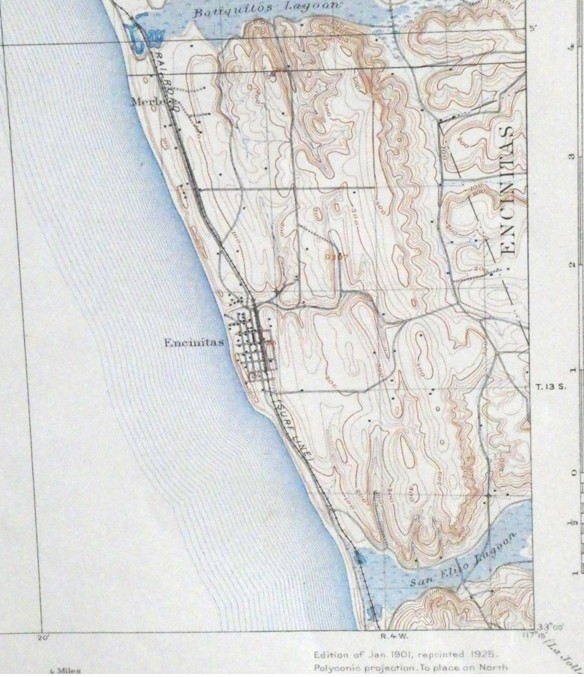
The geography of Encinitas tells a story. To the north, Batiquitos Lagoon. To the south, San Elijo Lagoon. To the east, the rugged canyon country of Escondido Creek — known to locals for generations as La Bajada. And to the west, the Pacific Ocean.
For most of its early history, Encinitas was not so much a connected community as an island caught between water and wilderness — more island than crossroads. The roads and bridges that transformed it into a connected, thriving city are among the most consequential public goods in local history. Their story unfolds in three distinct chapters.
Did you know?
Encinitas covers roughly 19 square miles. How many miles of publicly owned and maintained roadways does the City manage?
The answer is 169 miles — woven into every neighborhood, canyon, and corridor. That network exists because generations of residents and their elected representatives chose, again and again, to build and maintain it together.
THREE ROADS, THREE ERAS
Long before Encinitas was a city, El Camino Real (The Royal Road) threaded through the area, following ancient Kumeyaay inland paths to connect the scattered ranchos and settlements of North County. Along the coast, another dirt road was at last paved and widened in the early 1900s, transforming a sleepy connection into a commercial corridor. Hotels, garages and shops sprang up, and the town found its spine: Coast Highway 101, federally designated in 1926. Forty years later Interstate 5 cut through the region. Born from a 1956 Act of Congress and built with public funds, the freeway brought both excitement and conflict, dividing neighborhoods and galvanizing the communities that would incorporate as the City of Encinitas in 1986. Three roads, three eras, one through-line: El Camino Real connected settlements; Highway 101 connected economies; Interstate 5 connected regions — fast.
This timeline illustrates how roads—one of our most important public goods—developed over time.
HOW ROADS ARE PAID FOR
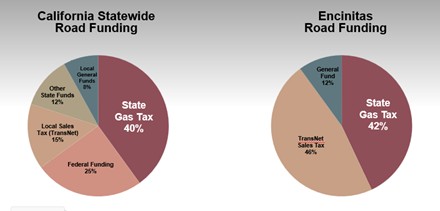
Roads deteriorate. They would become impassible if not assiduously maintained. How that maintenance is funded is more complex, and more collaborative, than most residents realize. Today, Encinitas road funding comes from multiple sources woven together through collective decision-making at every level of government. At our local level, 42% of funding comes from the California gas tax.
At the state level, 40% of the funding comes from the gas tax, 25% from federal funds, 15% from the local TransNet sales tax (itself approved by San Diego County voters), 12% from other state programs and 8% from cities’ general funds.
The gas tax, long the backbone of road finance, was designed in an era of exclusively gasoline-powered vehicles — which raises an urgent question for the road ahead.
THE FUTURE OF ROAD FUNDING
As electric vehicles become more common, road building and maintenance encounters a structural challenge. Electric vehicle (EV) drivers use the roads like everyone else — but they don’t buy gasoline, and therefore contribute little or nothing to the gas tax revenue that is the main source of financing road maintenance. Less gas tax revenue means less money for the roads everybody uses.
Several alternatives are under active consideration by state planners:
- mileage-based road usage fees,
- higher EV registration charges,
- tolls on specific corridors.
Each option involves tradeoffs, and each will ultimately be decided the same way road building and maintenance have always been decided — through collective choice, by voters and their elected representatives.
The debate is, in that sense, as old as the roads themselves.
Presented at MiraCosta College, March 24, 2026.
Video is available on the EHS YouTube channel here
ABOUT THE PRESENTERS

June Sekera is a public policy practitioner and scholar whose work focuses on the public economy and public goods production. She is a Senior Research Fellow at Boston University, where she works with the Economics in Context Initiative and an Honorary Senior Research Fellow at University College London, where she lectures on public goods and public value production. She is also a Fellow at The New School for Social Research, where she directed the Heilbroner Center’s Public Economy Project, and is the founder and Executive Director of the Public Goods Institute. She holds a Master’s degree in Public Administration from Harvard’s Kennedy School and is the author of The Public Economy in Crisis (2016).

Susan Sage is the Archive Project Manager at the Encinitas Historical Society, and Manager of the Public Goods Initiative. She develops and delivers educational presentations to the local community and works alongside the archivist to digitize, inventory, and catalog the Society’s historical archives. With over 30 years of experience in the technology sector — specializing in client engagement, project management, and education for global eCommerce companies — Susan has presented to Fortune 1000 companies across North America, Europe, and Asia. She now channels that expertise in training and presentation into making local history relevant and accessible to the next generation.

