The Invisibles
Hidden histories and revelations
about the public goods you use daily,
helped create, and often don’t see.
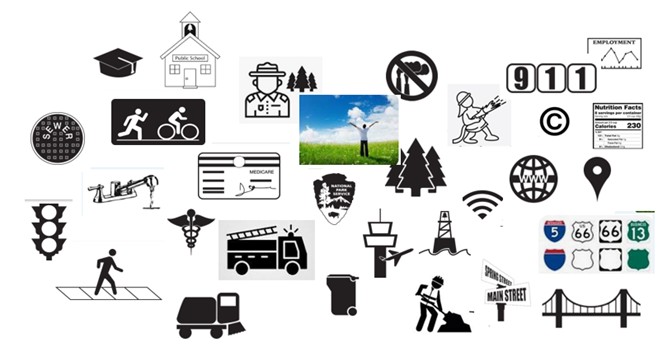
WHAT ARE PUBLIC GOODS?
You wake up in the morning, check the weather on your phone, brush your teeth, flush the toilet and drive to work or ride your bike to school on city streets. But the weather forecast, the clean tap water, the vanishing waste and the roads in good repair didn’t materialize by magic. And you didn’t buy any of those things at a store.
What you relied on this morning, as you do every morning, and all day long, are public goods: the services, products, rights, and benefits that we, as a polity, have voted into existence and chosen to pay for together.
Economist Martin Wolf frames public goods historically:
“The history of civilization is a history of public goods… The more complex the civilization, the greater the number of public goods that need to be provided.”
PUBLIC GOODS INITIATIVE
The Encinitas Historical Society has been exploring the history of public goods as it played out right here in North County. The story is rich and well documented in our archives. For example, 2026 marked a rare convergence of anniversaries with regard to a particular public good — roads: 250 years since El Camino Real first threaded through California and 100 years since the federal designation of Highway 101 in Encinitas. (For more on Encinitas roads and roadbuilding, go here.)
Such milestones are an invitation to look more closely at how so much of this community was built by the sustained effort of residents who chose, again and again, to create together the things they needed. With the considerable assistance of June Sekera and Susan Sage, the EHS has undertaken a Public Goods Initiative that explores and explains the historical context of public goods in Encinitas through documents, maps, oral histories, in-person presentations and online videos.
HOW WE GET PUBLIC GOODS
Public goods are not government handouts or academic abstractions. They are the shared infrastructure of daily life — the things a society decides it needs and that the market cannot or does not provide.
Physician and writer Atul Gawande puts it plainly: public goods are “necessities that can be provided only through collective effort and shared costs.”
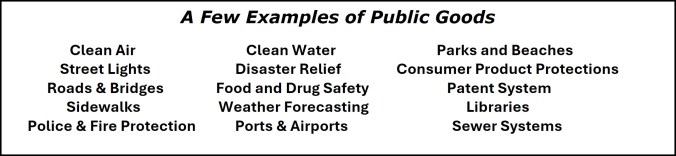
In democracies, public goods come into being through collective choice. People vote for representatives — a mayor, a city council, state legislators — who authorize and fund them. Or we vote directly, through initiatives and referenda. We pay for these products as a polity, through taxes and public finance. They appear “free” at the moment we use them. That’s because they are paid for by everyone, jointly.
THE PARADOX OF PUBLIC GOODS: INVISIBILITY IS A HALLMARK OF SUCCESS
There is a curious thing about public goods: the better they work, the less we notice them.
GPS guides us without our thinking about it. Clean water comes out of the tap. Food poisoning that don’t happen — thanks to county inspectors — are un-noticed and unrecorded. Bridges that don’t fall down, bank savings that aren’t lost, streetlights that work, beaches that are open to all: these are results of collective action that blend, essentially invisibly, into the background of daily life.
- To see how public roads and bridges transformed Encinitas from a virtual island to a regional hub, click here.
- To get a sense of the “municipal marvel” – the sewer system that makes your dirtiest problems just…vanish – click here.
- To learn about public goods of earlier eras, go here.
- To view videos of our presentations, click here to go to our YouTube page.
- To find out more about public goods, visit the Public Goods Post here.
Hours & Info
390 West F Street, Encinitas CA 92024
info@encinitashistoricalsociety.org
Open Saturday 10:00am-3:00pm (except holidays)
Research visits and private tours by appointment only
___________
TOPICS
How Roads Shaped the Encinitas Community

